Copaiba Oil: What It Is, How It Is Used, and Its Contraindications

Copaiba oil is sold across the Amazon and in almost every health shop in Peru, usually alongside a list of illnesses it supposedly resolves. That list is the reason for this article: what follows is what it actually is, what has been studied, and what cannot be claimed.
What copaiba oil is
It is not an ordinary essential oil. Copaiba is an Amazonian tree of the genus Copaifera — ours is Copaifera officinalis — that can grow past twenty metres. What is harvested is neither leaf nor seed, but an oleoresin that flows from inside the trunk: an oily liquid the tree produces in its internal ducts.
It is extracted by tapping the trunk and letting the oleoresin run. It is then filtered, decanted and distilled. The result is an oily liquid, bright yellow to brown, with a characteristic resinous smell and a refractive index between 1.4785 and 1.4990 at 25 °C.
That difference matters: an essential oil is obtained by carrying volatile compounds off with steam; copaiba comes out of the tree already liquid. That is why it is sometimes called a balsam, and why its composition looks nothing like lavender or eucalyptus.
Beta-caryophyllene, which is what makes it interesting
Copaiba is one of the richest natural sources of beta-caryophyllene, a sesquiterpene also found, in smaller proportions, in black pepper and clove.
In 2008, Jürg Gertsch and colleagues published in PNAS (105(26):9099-9104) a paper titled “Beta-caryophyllene is a dietary cannabinoid”, describing beta-caryophyllene as a selective agonist of the CB2 receptor, one of the two endocannabinoid system receptors, associated with regulation of the inflammatory response. The finding mattered because this is a compound present in ordinary foods that does not act on CB1, the receptor involved in the psychoactive effects of cannabis.
Read that precisely: it is mechanism research, done in cell and animal models. It describes how a molecule docks with a receptor. It is not a clinical trial in people with a specific condition, and it does not license the claim that a few drops of copaiba produce a measurable therapeutic effect. It is why copaiba interests researchers, not a promise of outcome.
What it is traditionally used for
In the Peruvian and Brazilian Amazon, copaiba oleoresin has centuries of documented use, in two ways: on the skin, applied to irritated areas, bites, minor wounds and areas of joint or muscle discomfort; and orally, a few diluted drops, traditionally associated with digestive and respiratory discomfort.
These are traditional uses, which is a different thing from approved uses. The distinction is not a technicality: it means there is a sustained practice, and no clinical dossier behind it.
How it is used
The recommended oral use in our technical datasheet is 3 drops dissolved in half a glass of warm water, on an empty stomach, once a day.
For topical use it is diluted in a carrier oil — coconut, almond, sacha inchi — before applying. Copaiba is mild compared with other oils, but it is still a resinous concentrate and skin varies. A patch test on a small area first is common sense, not excess caution.
Cautions
Our datasheet records no specific precautions under normal conditions of use. That said, there are reasonable cautions for any plant concentrate:
- Pregnancy and breastfeeding: safety data is insufficient. Ask first.
- Sensitive skin or dermatitis: always dilute and patch test.
- Anticoagulant or anti-inflammatory medication: discuss oral use with your doctor.
- Dose: more is not better. Drops are drops.
- Children: not given orally without professional guidance.
Frequently asked questions
What diseases does copaiba oil cure?
None. It is the most searched question and deserves a direct answer: copaiba oil is a traditional natural product, not a medicine, and there is no clinical evidence allowing anyone to credit it with curing any disease. What exists is a compound, beta-caryophyllene, whose mechanism is under investigation. Any site listing cured ailments is selling you something.
Is the oil the same as copaiba balsam?
Commercially they are used as synonyms, since both refer to the tree’s oleoresin. “Balsam” describes it better; “oil” is how it sells. What does differ is the degree of processing: a raw oleoresin and a distilled one are not identical.
Which tree does yours come from?
From Copaifera officinalis, in the Peruvian Amazon. The genus has several species and composition varies between them, so the scientific name on the label is not decoration.
Where ours comes from
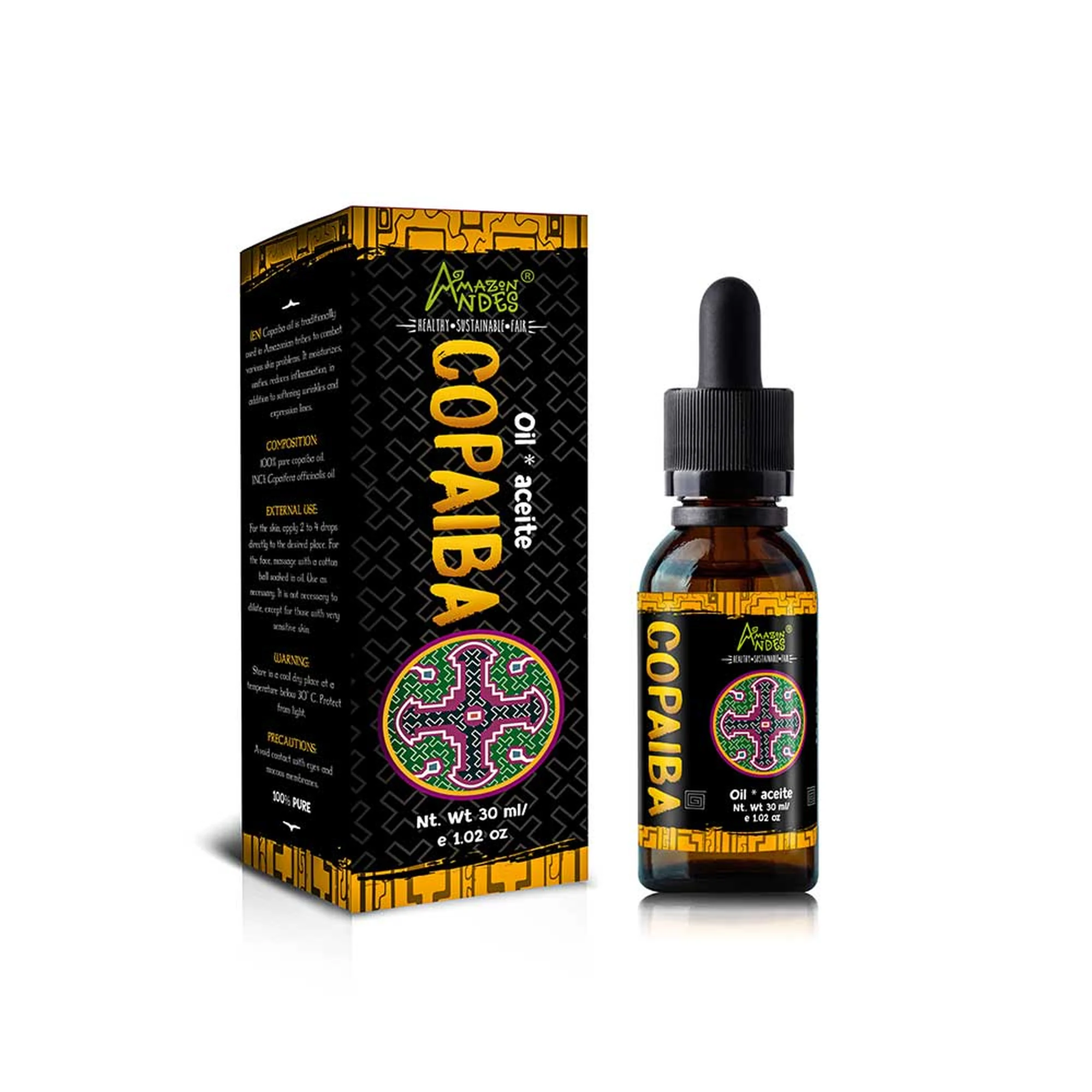
We work copaiba in the Ucayali region. The packaging carries a geometric kené pattern, the traditional design of the Shipibo-Konibo women of that region — not generic decoration, but the work of the communities where the product comes from.
This article is informational and describes traditional uses and mechanism research. It is not medical advice and does not replace consultation with a healthcare professional. It is not a medicine and is not intended to diagnose, treat, cure or prevent any disease.
Related products