Hercampuri: What It Is, How It Is Taken, and Its Cautions
Hercampuri is sold all over Peru as a detox herb and a weight-loss aid. Almost nobody mentions the thing that actually matters before starting: the official technical sheet warns against using it for more than a month at a time.
Here is what the plant is, what it is used for, how it is taken, and what is worth knowing first.
What hercampuri is
Hercampuri is Gentianella alborosea, in the gentian family. It is a tiny herb: no more than 5 cm tall, with centimetre-long lance-shaped leaves and small flowers, up to a centimetre and a half, in pink, pale lavender or yellow.
It grows on the puna, between 3,500 and 4,300 metres, in cold-climate areas: Puno, Cusco, Cerro de Pasco, Cajamarca, Huanuco, Ayacucho, Junin, Ancash and Amazonas. It is native to Peru.
It is also called bitter tea, Chavin tea, harcapura or simply chavin. The parts used are the stems and leaves.
Why it is so bitter
The bitterness is not a defect or a drying artefact: it is the composition. Hercampuri contains the bitter glycosides characteristic of gentians, among them amarogentin and gentiopicrin, plus erythaurin, gentianic acid, tannins, mucilage and volatile oils.
That family of bitter compounds is traditionally why gentians have been used as aperitifs and digestives across much of the world. The bitterness and the traditional use go together; the plant is not called bitter tea by accident.
What it is traditionally used for
The official Peruvian technical sheet records these traditional uses: stomach discomfort, support for liver and bile function, blood cleansing, fevers, obesity and varicose veins.
It is worth stating plainly what that means. These are documented traditional uses, a practice sustained over generations. They are not approved indications or effects demonstrated in clinical trials. Hercampuri is a food, not a medicine, and none of those applications has been through the kind of study that would let anyone state it as fact.
How it is taken
There are two ways, and the practical difference is the bitterness.
As an infusion
The traditional form: a teaspoon of dried leaves and stems per cup, hot water, a few minutes to steep. It tastes very bitter, and that taste is part of what it is used for, so heavy sweetening rather defeats the point. It is usually taken after meals.
In capsules
The way to avoid the bitterness. These are the recommended uses from our technical datasheets:
- Hercampuri capsules: 2 to 3 capsules a day, after meals.
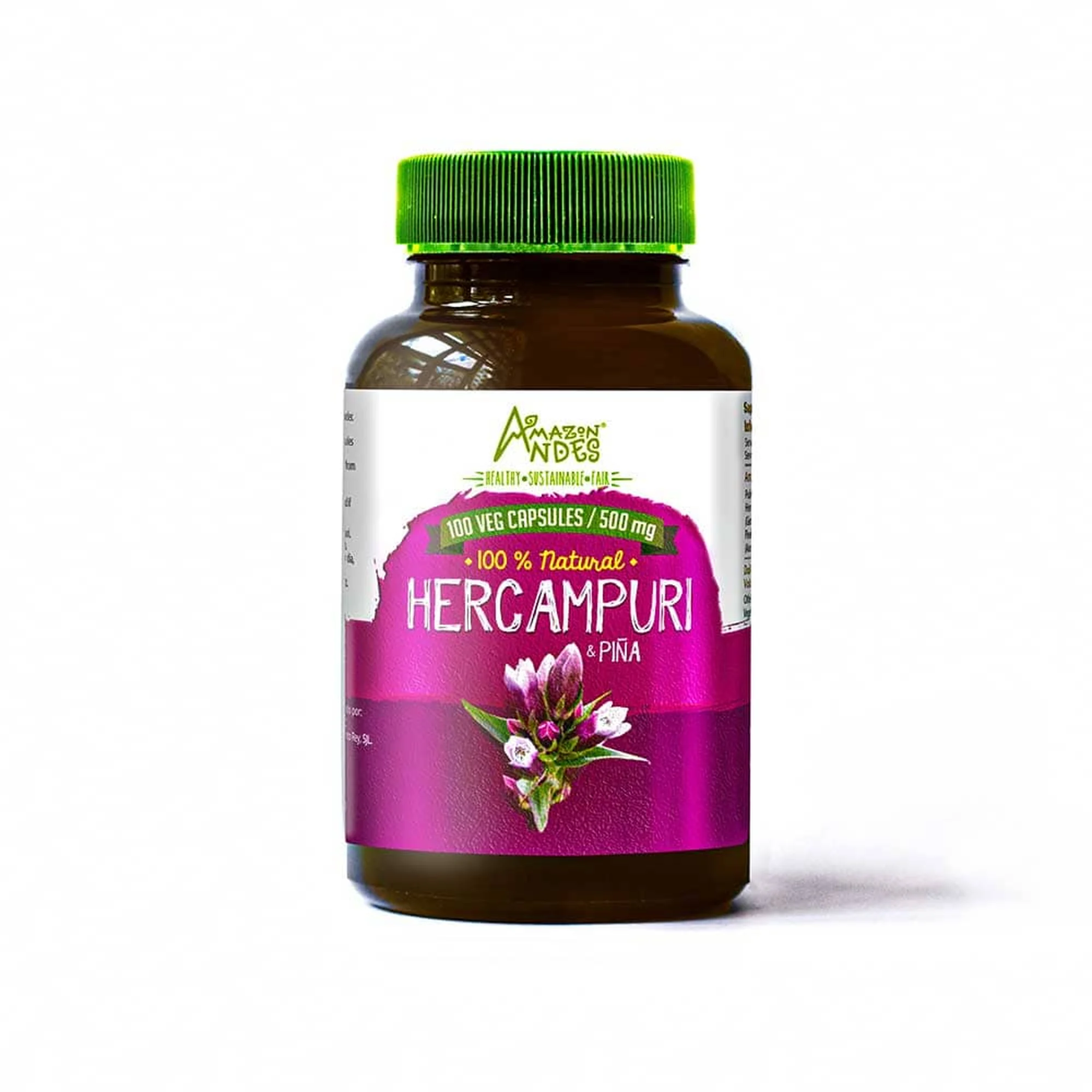
- Hercampuri with pineapple capsules (90% hercampuri, 10% pineapple, 500 mg): 2 capsules a day with plenty of water.
When not to take it
This is the section worth reading before buying, and the one missing from almost every page selling hercampuri.
- Not for more than a month at a time. The official Peruvian technical sheet warns that use beyond one month may have adverse effects on vision. It is a specific and little-circulated warning: if you take it, take it in periods and rest in between.
- Pregnancy and breastfeeding: do not administer.
- Very thin people: the same official sheet advises against it explicitly.
- Liver or cholesterol medication: discuss it with your doctor before combining.
A datasheet saying no adverse effects have been reported means exactly that: there are no reports. It is not proof of safety, and it does not cancel the one-month warning.
Frequently asked questions
Does hercampuri help with fatty liver?
Liver support is one of its traditional uses, but fatty liver is a medical diagnosis with specific causes and a management plan built on diet, weight and clinical follow-up. There is no evidence allowing hercampuri to be presented as a treatment. If you have been diagnosed, what changes the outcome is the prescribed treatment, not an infusion.
Does it make you lose weight?
It is traditionally used in that context and marketed that way, but no clinical trials support it. What is true is that it does not substitute for a calorie deficit or physical activity.
Is Chavin tea the same thing?
Yes. Chavin tea, bitter tea, harcapura and chavin are common names for the same plant, Gentianella alborosea.
Our hercampuri
We work hercampuri in capsules, from selected leaves, with DIGESA sanitary registration. Availability varies with the harvest season on the puna.
This article is informational and describes documented traditional uses. It is not medical advice and does not replace consultation with a healthcare professional. Food product: it is not a medicine and is not intended to diagnose, treat, cure or prevent any disease.