Dragon’s Blood (Sangre de Grado): What It Is, How It Is Used, and Cautions

Dragon’s blood is one of Peru’s best-selling Amazonian products and one of the worst explained. It gets credited with everything. It does have one thing almost no other Peruvian natural product can claim: this tree produced a drug approved by the United States Food and Drug Administration. Which does not mean what it appears to, and that is worth telling properly.
What dragon’s blood is
Dragon’s blood, known in Peru as sangre de grado or sangre de drago, is the red latex that flows from the bark of Croton lechleri, a tree in the spurge family that grows in the Amazon. Cut the trunk and a thick, dark red liquid runs out, much like blood — hence the name.
In Peru it is found in San Martin, Ucayali, Loreto and parts of Cusco, and across tropical America as far as the Guianas.
Extraction is by incision in the bark, preferably in the rainy season, when latex flow is greatest. It is then filtered twice, homogenised and packed. The tree is not felled: it is tapped, so harvesting can be repeated.
What it contains
- Taspine, an alkaloid, the main one in the resin and the one traditionally associated with its use on skin.
- Oligomeric proanthocyanidins, a group of polyphenols. The most studied is known as SP-303.
The fact almost nobody mentions, and its small print
From those proanthocyanidins came crofelemer, a purified, standardised active substance that the FDA approved for diarrhoea associated with antiretroviral therapy in HIV patients. According to the Memorial Sloan Kettering Cancer Center review, clinical trials with C. lechleri have shown effect in traveller’s diarrhoea and in diarrhoea in AIDS patients.
Now the small print, which is the point: crofelemer is a medicine; the bottle of resin is not. An isolated, purified, dosed active substance put through clinical trials is not the same thing as the tree’s raw latex, however shared the origin. That the drug exists proves the plant contains something that works; it does not turn the resin into that drug.
The rest of what is usually attributed to it — wound healing, gastric ulcers — has been seen in animals or in the laboratory, not confirmed in people. On cancer the same source is blunt: Croton lechleri has not been shown to treat cancer in humans.
What it is traditionally used for
On the skin
The most widespread use. Applied directly to insect bites, minor wounds and mild skin irritation. As it dries it forms a film that sits like a second skin.
Orally
A few diluted drops, traditionally associated with gastrointestinal discomfort.
How it is used
- Internal use: 3 drops of resin diluted in half a glass of warm water, on an empty stomach, once a day.
- External use: apply to the skin by hand or with cotton wool.
Shake the bottle before use: it is a resin and tends to separate. It stains clothes and tints skin red for a while, which is normal and fades.
Cautions
- Avoid contact with eyes and mucous membranes. The datasheet’s express caution, and the easiest to overlook when applying by hand.
- Pregnancy and breastfeeding: consumption is not advised.
- Children: keep out of reach.
- Deep wounds, extensive or infected burns: that is not mild irritation and needs medical attention, not resin.
- Medication: if you take anything regularly, ask before using it orally.
Frequently asked questions
Does it help with ulcers or gastritis?
Reduction of gastric ulcers has been observed in animals, but it is not confirmed in people. Gastritis and ulcers have specific causes, including H. pylori, and treatment with evidence behind it. Dragon’s blood does not replace it.
Why does it turn white when rubbed?
That is normal. Spread on skin, the red latex emulsifies and turns whitish or cream before drying into a film.
Are sangre de grado and sangre de drago the same?
Yes, two names for the same product. “Dragon’s blood” in English also covers resins from unrelated plants, so in international trade check the scientific name: Croton lechleri.
Our dragon’s blood
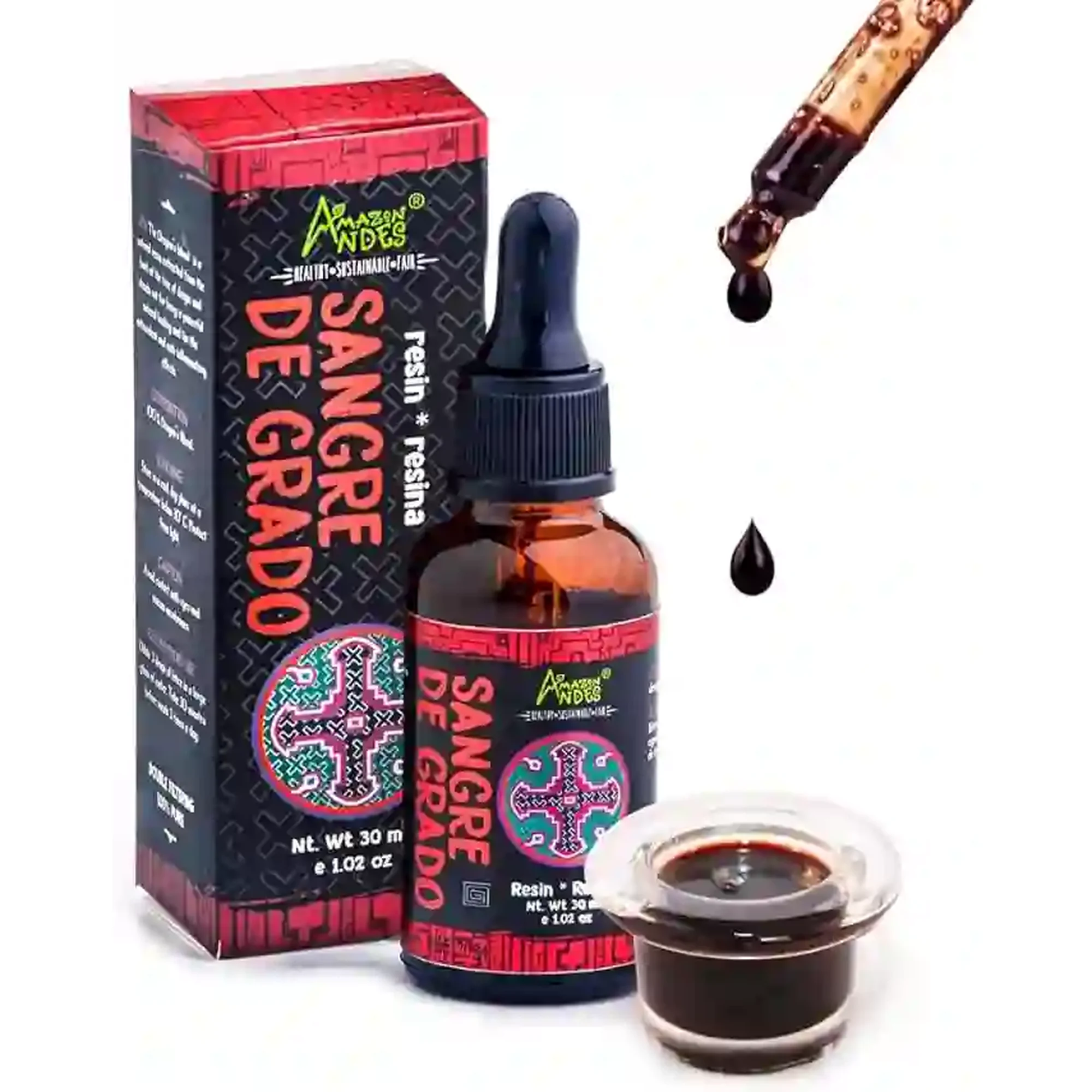
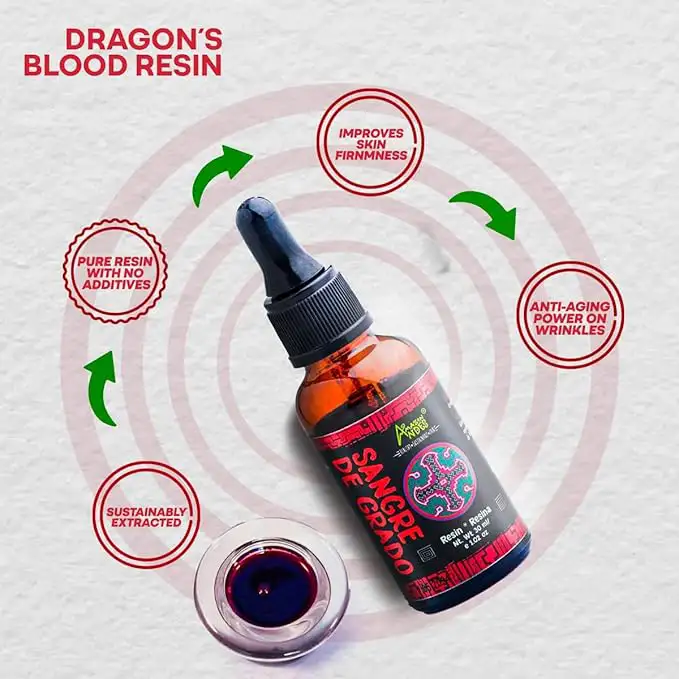
We work it in Ucayali, sustainably tapped by incision without felling the tree, filtered twice. The packaging carries the geometric kené pattern of the Shipibo-Konibo women of that region.
This article is informational and describes traditional uses and published research. It is not medical advice and does not replace consultation with a healthcare professional. It is not a medicine and is not intended to diagnose, treat, cure or prevent any disease.
Related products